

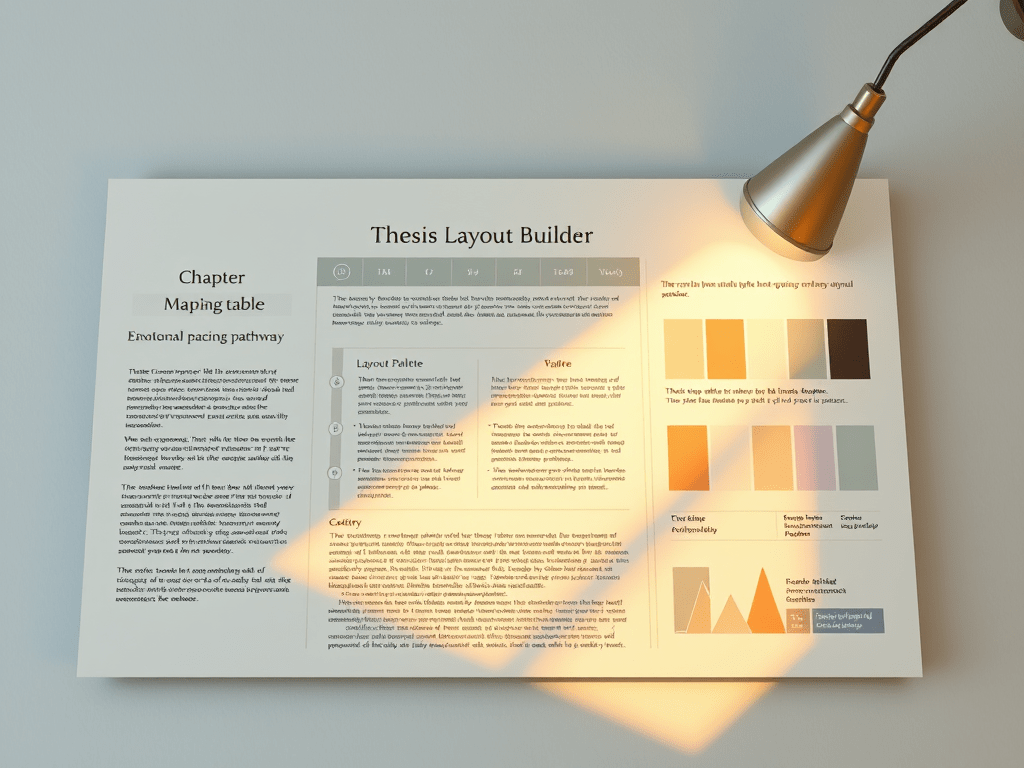
Structure That Thinks and Feels
Thesis Layout Builder: Structure That Thinks and Feels
This isn’t just a planning sheet. It’s a compass.
Academic work doesn’t have to be stiff. And structure doesn’t have to be a cage. This builder helps you shape your thesis layout as a space of clarity, rhythm, and care — for yourself and your reader. Whether you’re mapping chapters, designing emotional tone, or shaping visual pacing, every section is an invitation to think about layout as living architecture.
1. Chapter Mapping Table: Structure + Soul
Use this table to sketch the function, feeling, and flow of each chapter.
| Chapter Title | Anchoring Focus | Emotional Tone | Structural Features | Reader Impact |
|---|---|---|---|---|
| Introduction | Welcome + situate inquiry | Open, intentional | Layered headers, context blocks | “I see where this is going.” |
| Literature Review | Theoretical ground + mapping tensions | Critical, steady | Clean sub-sections, bold pivots | “They’ve done their homework.” |
| Methodology | Ethics, approach, reflections | Warm, transparent | Sidebars, reflection prompts | “I trust their methods.” |
| Findings | Story of data / key insights | Grounded, dynamic | Tables, annotated quotes | “I can follow their process.” |
| Analysis / Discussion | Meaning-making, weaving complexity | Bold, layered | Paragraph rhythm, pull-quotes | “This is insight-rich.” |
| Conclusion | Landing ideas + future possibilities | Uplifting, clear | Summary blocks, call-for-action | “I feel wrapped, yet invited.” |
| Appendices | Extra tools / process documents | Optional, functional | Accessible structure | “Depth is available, not forced.” |
This table can become a living guide. As you write, shift tones, add rhythm notes, insert layout clues.
2. Emotional Pacing Pathway
Sketch a timeline (digital or paper) that marks key emotional beats across chapters. Think of it as mapping energy and feeling through structure:
- Where’s the highest tension?
- Where do you slow the pace?
- Which chapters invite deep thought?
- Where does the reader need a breath?
Add colour coding, icons, or tone notes like: reflective pause, critical leap, dialogic turn, invitation to linger.
3. Layout Style Palette
Choose a layout energy for each section. Mix and match styles based on reader experience and content tone:
| Layout Style | Description | Best Used When… |
|---|---|---|
| Minimalist | Clean, white space, subdued visual cues | You want the reader to pause and reflect |
| Layered | Sections, sidebars, diagrams | Complex ideas need visual untangling |
| Narrative Flow | Storylike progression, rhythmic structure | You’re guiding emotion with design |
| Technical Framing | Grids, code blocks, formal structuring | High precision, dense data or tools |
| Accessible Soft | Generous spacing, headings with tone cues | Reader anxiety or fatigue needs care |
Pick one per chapter or mix within — what matters is intention.
4. Reflection Prompts to Anchor Design
Keep this section beside you while building:
- What’s the emotional arc of this chapter?
- Where do I want the reader to pause?
- How is layout helping me speak with integrity?
- Which design features amplify care, clarity, or curiosity?
- Where does structure feel too tight — and what needs space?
Sketch, scribble, annotate. Let the structure evolve with your writing voice.
5. Printable Companion Add-On (Optional)
I can help shape these into printable modules, including:
- Chapter Design Cards with fill-in prompts and tone sliders
- Layout Sketch frameworks with grid zones and white space cues
- Emotional Arc Maps with rhythm bars, breathing breaks, and pacing pulses
- Accessible Formatting Checklists based on care, rhythm, and visual equity
You’ll have a full suite to structure your thesis as an experience, not just a document.
For a full Thesis Layout Builder PDF…

Explore more with us:
- Browse Spiralmore collections
- Read our Informal Blog for relaxed insights
- Discover Deconvolution and see what’s happening
- Visit Gwenin for a curated selection of frameworks
 Gwenin: Clarity by Design