

Most people struggle with prioritisation because they try to treat everything as important. But if everything is important, nothing is.
Effective prioritisation requires filtering decisions through impact and effort.
Start by listing tasks or responsibilities. Then evaluate each one based on:
- Impact: How much does this actually move things forward?
- Effort: How much time or energy does it require?
High-impact, low-effort tasks should always come first. High-impact, high-effort tasks should be scheduled intentionally. Low-impact tasks should be reduced or eliminated.
This creates a clearer structure than simple urgency-based prioritisation, which often leads to reactive behaviour.
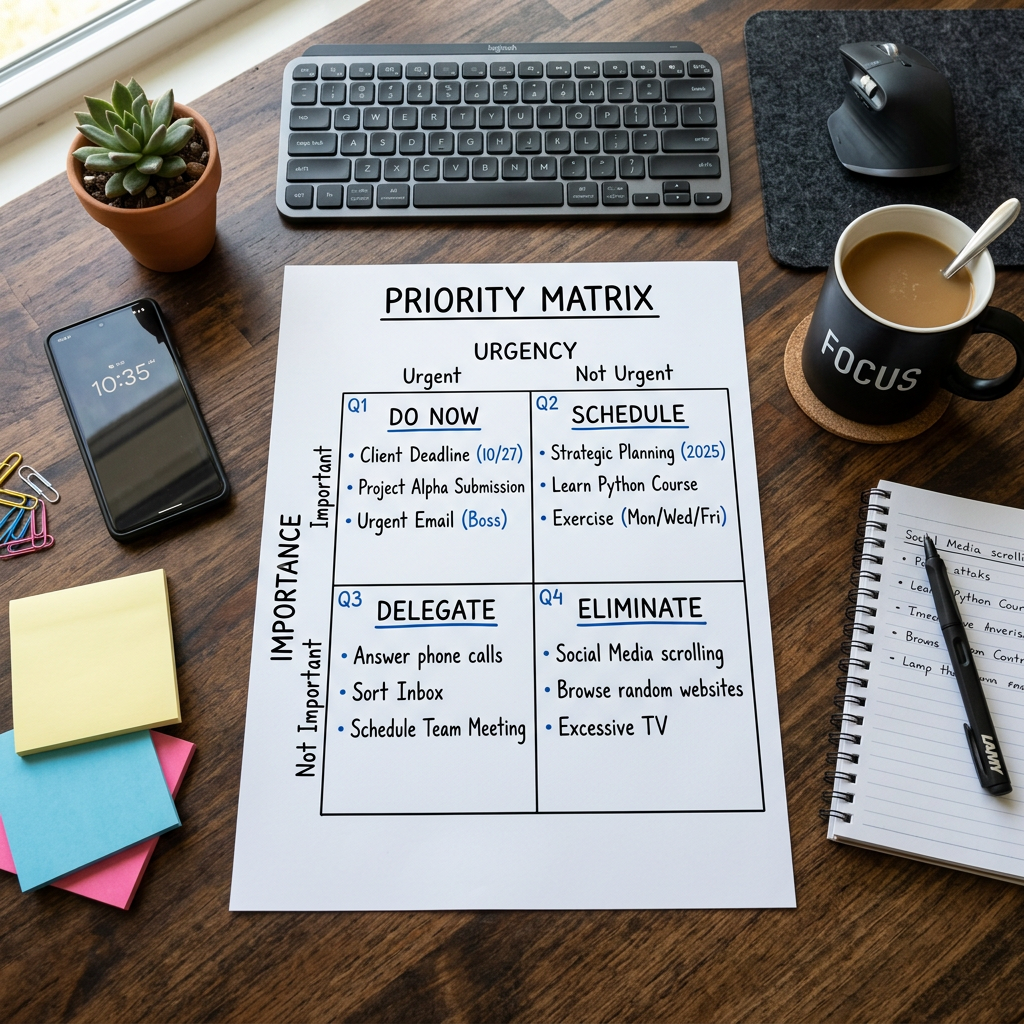
A useful framework for this is the Eisenhower Matrix, which separates tasks by urgency and importance:
https://www.eisenhower.me/eisenhower-matrix/
The key insight is that prioritisation is not about doing more; it is about removing everything that doesn’t matter enough.
